

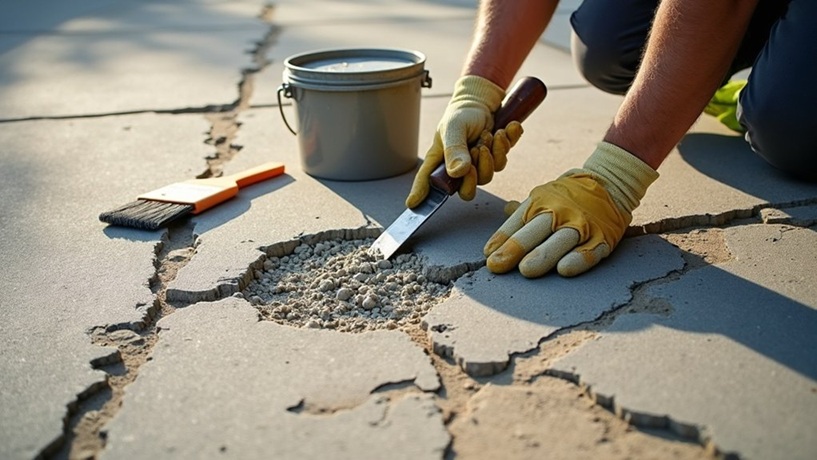
Spalling concrete repair is one of the most consequential maintenance challenges facing property owners in Singapore, where the tropical climate relentlessly accelerates the deterioration of reinforced structures. Like the collapse of past civilisations that failed to manage their environmental pressures, buildings that ignore concrete degradation invite a slow but decisive structural decline. Understanding what drives this process, and how to reverse it, is essential knowledge for anyone responsible for maintaining a concrete structure in this part of the world.
What Is Concrete Spalling?
Concrete spalling occurs when the surface layer of a concrete structure fractures and breaks away, exposing the steel reinforcement beneath. The word “spalling” describes the flaking, chipping, or delamination of the concrete surface, and it is rarely a cosmetic issue alone. Once reinforcement bars are exposed to moisture and oxygen, the oxidation process begins almost immediately. In Singapore’s humid conditions, with annual rainfall exceeding 2,300 millimetres, that chemical clock ticks faster than in drier climates.
The mechanics are worth understanding clearly. Concrete is inherently alkaline, and this alkalinity protects embedded steel from corrosion. Over time, however, atmospheric carbon dioxide reacts with calcium hydroxide in the concrete to form calcium carbonate. This process, known as carbonation, progressively neutralises the concrete’s alkalinity. Once the carbonation front reaches the steel reinforcement, corrosion begins. Rust occupies a volume approximately four times greater than the original steel, generating expansive internal pressure that eventually fractures the surrounding concrete from within.
Common Causes of Spalling in Singapore
Several environmental and construction-related factors contribute to spalling concrete in the local context.
Chloride ingress
Proximity to the sea, which affects many residential and commercial developments near the coast, accelerates chloride penetration into concrete. Chloride ions are highly effective at breaking down the passive protective layer on steel.
Carbonation
As described above, this is particularly prevalent in older structures where concrete mix quality may not have met modern standards.
Inadequate concrete cover
If the depth of concrete over the reinforcing steel is insufficient, moisture and carbon dioxide reach the bars more quickly. BCA guidelines specify minimum cover depths precisely to prevent this.
Poor construction practice
Honeycombing, improper curing, or low-quality mix designs create pathways for water ingress that would not exist in properly constructed concrete.
Thermal cycling
Daily temperature fluctuations, though moderate compared to temperate zones, still cause micro-cracking over decades of exposure.
Recognising the Warning Signs
Early identification of spalling concrete significantly reduces the cost and complexity of repair. The most reliable indicators include:
Rust staining
Brown or orange streaks running down a facade often indicate that embedded steel is already corroding.
Cracking patterns
Map cracking or longitudinal cracking along the line of reinforcement bars are diagnostic signs.
Hollow sounds
Tapping the concrete surface with a hammer produces a distinctly hollow resonance where delamination has occurred beneath the surface.
Visible delamination
Bubbling, blistering, or loose fragments of the concrete surface itself.
A qualified structural engineer should be engaged once any of these signs are identified. In Singapore, MOM workplace safety regulations also require that remedial work at height or in confined spaces be conducted under appropriate supervision.
Spalling Concrete Repair Methods
The appropriate repair strategy depends on the extent of deterioration, the depth of corrosion, and the structural role of the affected element. A local contractor experienced in concrete spalling repair would typically provide a detailed assessment before recommending a method.
Surface Patch Repair
For localised, shallow spalling where structural integrity is not compromised, surface patch repair is the standard approach. The deteriorated concrete is cut back to sound material using a disc cutter or chipping hammer, and the exposed reinforcement is cleaned of all rust, typically by wire brushing or grit blasting. A corrosion-inhibiting primer is then applied to the steel before a polymer-modified cementitious mortar is packed into the prepared recess in layers. Repair mortars such as those based on shrinkage-compensated or fibre-reinforced formulations are commonly specified to minimise cracking risk.
Full-Depth Concrete Reinstatement
Where corrosion has compromised the cross-section of the reinforcing steel, full-depth reinstatement may be necessary. This involves removing concrete well beyond the corroded zone, sometimes requiring the installation of additional reinforcement before recasting the section. This is more disruptive but may be the only structurally sound option for load-bearing elements.
Electrochemical Treatment
For large-scale or chloride-contaminated structures, electrochemical methods such as cathodic protection or chloride extraction are used. These techniques arrest the corrosion process rather than simply covering it, offering long-term protection particularly suited to coastal or marine environments.
Prevention and Long-Term Management
The most cost-effective approach to spalling concrete repair is, wherever possible, prevention. Applying penetrating sealers or silane-siloxane coatings to concrete facades creates a hydrophobic barrier that slows carbonation and chloride ingress without altering the appearance of the surface. In Singapore’s public housing and commercial sectors, cyclical facade inspection programmes are increasingly standard practice, driven in part by regulatory requirements under the Building Control Act.
Routine inspection every three to five years, combined with prompt attention to surface cracking or rust staining, can extend the serviceable life of a concrete structure by decades. As with ecosystems that collapse only after years of incremental stress, concrete structures give ample warning before they fail. The difference between a manageable repair and a structural crisis often comes down to how quickly those early signals are recognised and acted upon.
Spalling concrete repair, properly understood and executed, is not merely a remedial exercise. It is a systematic intervention in a predictable chemical process, and one that every responsible property owner in Singapore should approach with the same rigour they would apply to any other long-term asset management decision.