
An insurance adjuster on a storm-damaged roof is answering two questions. Did a covered weather event hit this address on a specific date? Did that event cause the damage being claimed? Granule loss from age, heat blistering and old patch jobs look different from fresh hail strikes or wind creases. The file has to make that difference obvious to someone who may spend less than an hour on site.
Knowing how a roofer documents storm damage for an insurance claim explains why the work follows a fixed order. Weather data comes first. Then the ground, the roof, the measurements and finally the meeting with the adjuster. Each stage produces its own kind of evidence. A gap in an early stage is hard to fix later, especially once tear-off has started and the original surface is gone.
Around the Oklahoma City metro, Streetside Roofing Solutions builds this kind of file as the center of its insurance claims advocacy. The team is rooted in Mustang and works with homeowners in Yukon, Oklahoma City and Piedmont. It handles the documentation, explains the scope to adjusters and keeps communication clear between the household and the carrier after hail and wind events. The licensed contractor (CIB# 80008088) also handles gutters, exterior paint and garage doors, which often take hits in the same storm. Inspections can be booked on weekdays from 8AM to 5PM at (405) 650-2618.
The Storm Record Comes Before the Ladder
- Pin down the date of loss. The homeowner’s memory, neighbors’ reports and local news all help. The date matters because coverage is tied to a specific occurrence, and a second storm weeks later can blur which event caused what.
- Check the preliminary reports. The Storm Prediction Center’s daily storm reports list hail and wind reports by time, county and coordinates. Hail size is logged in hundredths of an inch, so an entry of 175 means stones 1.75 inches across. Each page runs from 1200 UTC to 1159 UTC the next day. As a result, an evening Oklahoma storm shows up on that calendar day’s page. SPC labels all of these reports preliminary.
- Add the verified record later. NOAA’s Storm Events Database holds records back to 1950. It is updated monthly, and entries can take up to 90 days to appear, so a file often starts with the SPC report and gets the official entry added afterward.
- Note the distance. Hail swaths can be narrow. A report two miles away supports the claim but does not prove hail fell on this particular roof. That is what the next stages are for.
Ground Evidence Before Anyone Climbs
- Open with an address shot. A photo of the front elevation with the house number visible anchors every image that follows to the right property.
- Photograph soft metals. Gutters, downspouts, roof vents, AC condenser fins and mailboxes dent easily. The size and depth of those dents give a rough read on stone size.
- Record the direction. Hail driven by wind usually marks one or two sides of a house far more than the others. A pattern on the west and north faces that matches the storm’s track is strong supporting evidence.
- Separate fresh from old. New dents on painted metal often show bright spots where impact knocked off oxidation, and those marks fade over time. Torn window screens, dented garage door panels and chipped siding paint are logged as collateral damage.
On the Roof With Chalk and a Tape Measure
- Label every slope. A wide shot of each slope, with a chalked N, S, E or W visible, keeps close-ups from floating around without context.
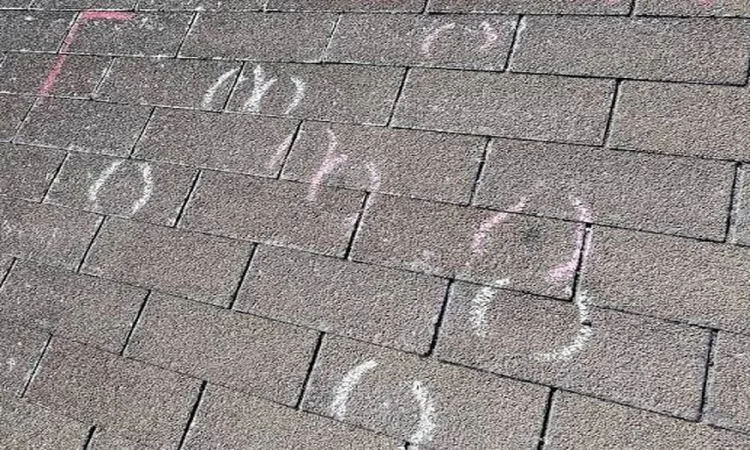
- Mark test squares. A common method is a 10 by 10 foot square chalked on each slope, with every hit inside it circled and counted. How many hits justify repair or replacement is set by the insurer and varies by carrier.
- Shoot close-ups with scale. A tape measure or coin beside each hit shows its size. A true hail bruise feels soft when pressed, has displaced granules and can fracture the mat underneath.
- Log wind damage separately. Creased tabs, broken seal strips and missing shingles are photographed and counted per slope, because wind and hail can fall under different deductibles.
- Flag what is not storm damage. Blisters, foot traffic scuffs and old repairs get noted too. A file that admits wear where it exists is more credible on everything else.
| Claim stage | What gets documented | Why it matters to the adjuster |
|---|---|---|
| Weather check | Date of loss, SPC report, NOAA database entry, distance to address | Ties the damage to one specific event |
| Ground walk | Address photo, soft metal dents, gutters, screens, garage door | Shows stone size and direction without climbing |
| Roof inspection | Labeled slopes, test squares with hit counts, scaled close-ups | Separates storm hits from age and wear |
| Measurements | Squares, pitch, layers, vents, flashing, drip edge | Builds the line items in the estimate |
| Temporary repair | Tarp photos, time stamps, receipts | Shows steps taken to stop further damage |
| Tear-off | Hidden layers, decking condition, code items | Supports supplements for items unseen at first |
Measurements, Tarps and the Paper Trail
- Measure everything. Total squares, pitch per slope and the number of shingle layers drive material and labor figures. Aerial measurement reports are checked against hand measurements.
- Inventory the components. Pipe boots, vents, flashing, drip edge, starter strip and ridge cap each become a line item. If an item is left out of the inventory, it is easy to leave out of the estimate.
- Document temporary protection. The Oklahoma Insurance Department tells storm-affected homeowners to take plenty of photos or video, make the repairs needed to prevent further damage, and keep everything unless the insurer says otherwise. Tarping gets photographed before and after, and the receipt goes in the file.
- Keep original files. Unedited photos keep their time stamp and location data. That metadata backs up the date of loss far better than a caption does.
Adjuster Day and the Supplement
- Walk the roof together. The roofer shows the test squares and slope photos. The adjuster may chalk their own squares, and comparing the two counts on site settles a lot of disagreements early.
- Review the estimate line by line. When the carrier’s estimate arrives, each item is compared against the measurements and component inventory.
- Document what tear-off reveals. A second shingle layer hidden under the first, or decking that has to be replaced to meet code, is photographed sheet by sheet before new material goes down. Those photos support a supplement request.
- Keep the roles clear. The roofer documents and explains the scope. Negotiating the settlement belongs to the policyholder or a public adjuster, who must be licensed by the state. Many Oklahoma policies carry a separate wind and hail deductible, sometimes set as a percentage of dwelling coverage, and that amount is the homeowner’s to pay.
What the File Does and Does Not Do
A thorough file does not decide a claim. The policy sets coverage, exclusions and the deductible, and the insurer makes the call. What good documentation does is take guesswork out of the conversation. The adjuster sees the storm report, the directional pattern on the gutters, the chalked squares and the scaled close-ups in one sequence, and every photo traces back to a date and an address.
The timing matters as much as the photos. State guidance warns homeowners not to make permanent repairs until the insurer has inspected and agreed on the cost. That makes the window between the storm and the inspection the only chance to capture the roof exactly as the hail left it. If a homeowner believes the claim was handled improperly, the Oklahoma Insurance Department takes complaints and reviews whether the carrier followed state law.