
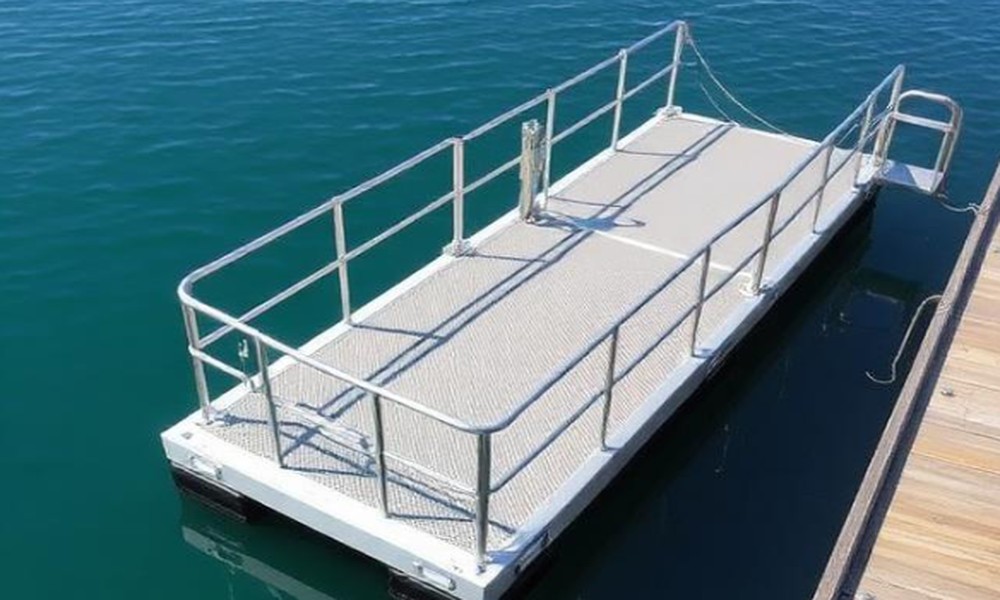
From shore, a floating dock appears simple. You can tie a few modules, drop some anchors and call it a night. Water will tell you differently. The best installations are the result of careful planning and making small, disciplined decisions. Here are some of the most common mistakes and how to avoid them.
Skip real site assessment
Guesswork can be costly. Not just the average depth, but also the depth at low-water. Take note of the wind direction, currents, wake traffic and debris collected after storms. Test the bottom. Each type of soil, whether sand, muck or rock seams requires a different method. An hour-long survey can save you weeks of frustration.
Anchors that are too small or incorrectly placed
The anchoring system is at the core of any floating dock. The dock will wander if it is too light. If the scope is too short, then every wave will snap the chain. Select the anchor type that is appropriate for your bottom, and not one you would like to have. Consider the catenary’s weight and use a pattern that will resist your dominant forces. For stability, triangles are more stable than straight lines.
3) Ignoring the freeboard and vessel mixture
The freeboard that is perfect for kayaks can be a nuisance to tall outboards. It is also true in the opposite direction. Deck height should be matched to the boat you are actually tying up. Plan zones or a finger with a low freeboard for small boats if you are hosting a mix. The step is more important than the color.
4) Selecting the wrong modules and floats
All floats are not the same. In rough seas, thin-walled units with low buoyancy flex and squeak. The surface will feel calmer if you use floats that are heavy, well-sealed and have a sufficient reserve. Check the buoyancy per sq. foot, the thickness of the shell, and its UV resistance. Weigh your corners and hinges in the math.
5) Weak hinges and connectors
The connections are the ones that carry the battle. The connections wear out quickly if they are too small, have thin brackets or soft fasteners. Hardware rated to the load you have modeled should be used. Where possible, use through-bolts. Isolate dissimilar metals. Store spare pins nearby. It is better to have a spare hinge ten feet from the original than a hinge that is perfect in a catalogue.
6) Bad layout for wind and wave
A beautiful rectangle can be an ineffective sailor. Align your long axis to the prevailing wind direction and boat approach. If your site is hammered at weekends, add wave-attenuating segments or sacrificial finger. Keep turning pockets to the ends. The layout should flow. This reduces the stress of all parts.
7) Forgetting future utilities
Power, water and lighting need protection and paths. Plan conduit routes, drip-loops, and strain reliefs before the first bolt. Pull strings can be left. Add extra junction capacity. Design the connection points if you may add a finger, or a kayak launch in the future.
8) Looking at gangway slopes and clearances
Local rules can be violated by steep gangways. Measuring slope at low water, mid-water, and high water. Landings are required where necessary. Verify that the gangway won’t collide with docks at extreme heights. The hinge pins should move smoothly and without binding.
9) Use of the wrong fasteners
Hardware is inexpensive compared to the cost of labor. Stainless steel or alternatives that are properly coated, such as marine-grade stainless steel, matter. Carelessly mixing metals will lead to corrosion. Use locking nuts and correct washers. Also, check the torque. One loose cleat is enough to cause a series of problems.
Neglecting the cleat and fender layout
Boats will kiss the same places over and over again. Install fenders and rub rails in predictable contact areas. Stagger cleats to a sensible distance. Where heavy lines are to be placed, reinforce the backing. If you ignore your weak spots, the first weekend of tie ups will show them.
Skipper permits and local rules
The rules for the waterfront are different. Even color temperature, eelgrass assessments, setbacks and lighting can be regulated. Permits may seem slow, but they are protecting your investment. Forced rework takes longer.
No tuning after installation
The first day is not the end. After the first blow, recheck anchor scope. Retorque the hardware. Watch hinge wear. Adjust any lines that vibrate in the wind. Small issues can be fixed with a one-month or three-month check.
Dockside checklist:
- Bottom type, depth at lowest water, pattern of wake, fetch, and depth at lowest water
- Anchor type, weight and scope diagram
- Freeboard targets and hinge and pin specifications, as well as module buoyancy.
- Landing needs at three tide levels and a gangway slope
- Labeling spare parts, utility routing, strain relief and labeling
- Fender plan, cleat spacing, backing plates
- Conditions of permit, signage and lighting requirements
- Inspections after installation on a schedule
It is not an accident that a floating dock feels so composed. Honest measurements, the right hardware size, and a layout that is tuned to your water are the key factors. If you avoid these mistakes, your weekends will be spent on the deck and not underneath it.
This post was written by a professional at Supreme Marine Floating Docks. Supreme Marine Floating Docks is dedicated to providing top-quality floating dock for sale Ft Lauderdale and marine accessories that combine durability, innovation, and superior performance. While we are a new brand, our team brings over 50 years of combined industry experience, making us a trusted name in the marine world. We are passionate about designing and delivering products that meet the highest standards, ensuring reliability and longevity in all marine environments. Whether for residential, commercial, or recreational use, our docks are crafted with precision and care, setting a new benchmark in the industry. At Supreme Marine, we don’t just build docks-we create lasting solutions.